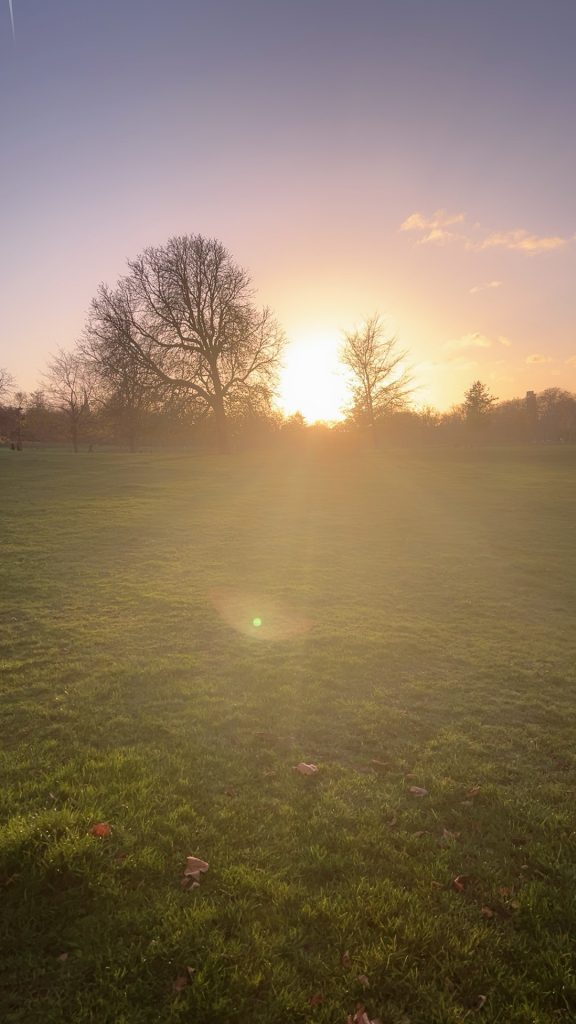
• This week our class went to Greenwich Park for a field walk. It was on Monday, and the weather was calm. At the start of the walk we did an exercise where we put on eye masks and walked in the park without seeing anything. I had never tried this before. When I lost my vision, all the sounds around me became much louder. Sounds that I usually ignore in daily life suddenly felt very close. I could hear the wind moving through the leaves, footsteps in the grass, people talking far away, and even small changes in the ground under my shoes. Without sight it was also hard to keep my balance. My body kept trying to guess the space around me, and every small sound became a guide.

    After that exercise we started recording. We used contact microphones to collect different sounds in the park. I recorded the wind moving on thin branches, the sound of dry leaves being stepped on, some birds and small animals calling, and also the sharp sound of hitting wood with a stick. Contact mics made these textures feel very detailed, almost like hearing the inside of the object.

    Later we walked to an underground tunnel that looked a bit like an air raid shelter. It was darker and had a very different atmosphere. People were walking through it, and the space had a long natural reverb that made every footstep echo. We recorded the tunnel using contact mics and also captured the electromagnetic sound inside the lift next to it. The whole space felt heavy and industrial.

    This field walk helped me notice sound in a more focused way. I realised that many interesting textures are always around us, but we ignore them because we are too used to visual information. Recording with contact mics also showed me how different objects can become sound sources for composition. I think these recordings will be very useful for my future projects, especially if I want to build a strong atmosphere or use natural textures in my work.
  • Today we had a guest lecture by Dr. Nat Raha, and she also did a live poetry performance. Before this lecture I did not know much about her, but after seeing the performance I felt that her way of using sound and poetry was very special.

    She started by playing recordings of her own poems. The recordings were layered on top of each other, so the voices sounded like they were mixing and talking to each other. Some lines were clear and some were hidden, and it created a very emotional atmosphere. After that she read the same poems live in front of us while the recordings were still playing in the background. This made the whole performance feel more powerful, almost like past and present were happening at the same time.

    I noticed how she used her voice in different ways. Sometimes it was soft, sometimes stronger, and sometimes she paused on certain words. Even though she was reading poetry, it felt a lot like sound art. The layers, the timing, and the space of the room all became part of the performance.

    She also talked about her work and how poetry can express political feelings, identity, and personal experience. I learned that sound does not always need to be music. A voice, a line of text, or even silence can create meaning.

    This lecture made me think about how I can use my own voice in my projects, not just as vocals in music but also as a sound element on its own. I liked how she showed that poetry can be sound art when you think about texture, rhythm, and emotion.

    Website: https://www.gsa.ac.uk/staff/user-1787

  • Sound Arts Guest Lecture: Tingying Dong

    This week we had a guest lecture in Lecture Theatre B by Tingying Dong. She is a sound designer and composer who works in theatre. The lecture was on November 6th, and after listening to her talk, I felt inspired and wanted to try something new.

    Tingying is from Beijing and later moved to London to work in theatre. She said that sound is not just something in the background, but something that can push the story forward and make the audience feel part of it. She showed some examples of her work, and I was surprised how small sound details, like the sound of a door or the wind, can completely change how people feel.

    She especially likes working on psychological thrillers, where sound shows the character’s inner emotions. She also said that sound, space, and actors’ movement all work together, not separately. This idea really touched me, because I often focus too much on making vocals sound “good,” and forget about the emotion or story behind them.

    From this lecture, I learned that sound design needs observation and teamwork, not just technical skills. I want to start adding small sounds into my own projects to express people’s thoughts and emotions, not just to make things sound nice. Overall, this lecture opened up my mind and made me realize that sound can go much further than I used to think.

    Website: https://www.tingyingdong.com/

  • Introduction

    I wasn’t able to join the class visit to Longplayer at Trinity Buoy Wharf, but I went there by myself afterwards. Experiencing the piece in its real location was very different from only reading about it. Being in the lighthouse space where the work is installed gave me a direct sense of its atmosphere and scale.

    Description of the Work

    Longplayer is a sound art project by Jem Finer, first performed on the 31st of December 1999. It is designed to last for 1000 years without repeating. The sound is generated from Tibetan singing bowls, processed in layers so that it slowly evolves over time. The installation at Trinity Buoy Wharf creates a unique listening environment, where the continuous sound blends with the architecture and the outside surroundings of the Thames.

    Review and Reflection

    What impressed me most about visiting Longplayer was how slowly the sound develops. At first it almost feels static, but after staying there for some time I began to notice subtle changes and patterns. It made me think about time in a very unusual way — not only the minutes I was sitting there, but also the idea that this same piece will keep playing long after my own lifetime.

    In relation to Steven Connor’s text “Ears Have Walls”, Longplayer shows how sound art offers a very different experience compared to visually-led artworks in galleries. Gallery art is often encountered quickly, with the eyes moving from piece to piece. Longplayer, however, demands listening over a long duration, and it transforms the space into something immersive and almost meditative. It also connects with the environment outside, as the faint city sounds and river atmosphere mix with the piece itself.

    Conclusion

    Visiting Longplayer on my own gave me the chance to engage deeply with its concept of duration and continuity. I think the work is successful in pushing listeners to reflect on time, memory, and the future. It shows how sound art can go beyond the limits of visual display, creating an experience that is both personal in the moment and universal across generations.

  • Luigi Russolo’s Intonarumori (Noise Intoners, c.1916)

    In 1913, Italian Futurist artist Luigi Russolo published his manifesto The Art of Noises, arguing that modern life had outgrown the traditional sounds of the orchestra. He believed that the industrial age, with its machines, engines, and urban noise, demanded a new musical vocabulary (Russolo, 1913). To realise this vision, he created the Intonarumori (“noise intoners”), a family of experimental instruments built around 1916.

    The Intonarumori were wooden boxes with mechanical parts and levers attached to large horns, designed to produce sounds such as roars, whistles, and hums. Russolo classified these noises into different categories, showing his systematic attempt to expand music beyond conventional harmony. The instruments were used in Futurist concerts in Italy, where they often provoked controversy. Some audiences were fascinated, while others reacted with hostility to the intrusion of noise into the concert hall (Kahn, 1999).

    This invention is significant because it connects directly to modernism. Modernist art was defined by innovation, the rejection of tradition, and a desire to respond to social and technological change. Russolo’s embrace of noise challenged the boundaries of music and reflected the modernist spirit of experimentation. His work also anticipated later practices in sound art, musique concrète, and electronic music, making him an important precursor for 20th-century sonic experimentation (Tate, n.d.).

    Although most of the original instruments no longer survive, Russolo’s ideas remain influential. Reconstructions of the Intonarumori have been built in recent decades, allowing contemporary audiences to experience the sounds that once shocked early 20th-century listeners. Today, Russolo’s project is recognised as a key step in establishing sound as a legitimate artistic medium (Kahn, 1999).

    • Kahn, D. (1999) Noise, Water, Meat: A History of Sound in the Arts. Cambridge, MA: MIT Press.
    • Russolo, L. (1913) The Art of Noises. Futurist Manifesto.

    • Three keywords
    • Performance
      For me, performance is not only about playing music, but about creating the full energy of a live event. As someone who has organised and performed in clubs, I know that the performer’s state, confidence, and even clothing all shape how the audience experiences the music. Performance turns sound into an atmosphere where people can fully connect with what I create.On Screen
      Visuals are just as important as sound when I perform. The background screen, projections, and lighting all help build the atmosphere and make the music feel more alive. I see visuals as a way to translate the emotions in my music into a shared experience for the audience, making the live set unforgettable.Sculpture
      I think of sound as a kind of sculpture in space, something that moves around the listener and changes the way they feel inside the venue. In a club setting, the arrangement of speakers, lights, and installations can make people feel like they are inside the music. This inspires me to explore sound as an immersive environment, not only as music but as a space people can step into.11th October 2025
  • Background
    I have been making my own music for some time, and at first I thought I would study music production. But because I already know how to produce, I wanted to try something different. I feel that if I only stay in music production, I will just repeat what I already do. That is why I chose sound art.

    Why Sound Art
    For me, sound art feels more open. It does not follow the same rules as music, like structure or harmony. It makes me think differently about sound—not only as songs but as something that exists everywhere. Everyday sounds, like conversations, city noise, or natural environments, can all become part of an artistic experience. I want to explore how recording and shaping these sounds can tell a story, or make people feel something unexpected.

    My Goals
    Another reason I am curious about sound art is because it connects with space and visual elements. In music production, I usually sit in front of a computer, but in sound art I can use sound in physical places, installations, or performances. At this early stage, sound art means discovery. It means looking at sound from a fresh perspective and finding inspiration in things I normally ignore. I want to use this course to open my ears wider, and see where it takes me as an artist.


  • Welcome to myblog.arts. This is your first post. Edit or delete it, then start blogging!